
IndabaX South Sudan 2026: Learning, Building and Showcasing AI in Juba
IndabaX South Sudan 2026 brought together students, developers, researchers and founders in Juba to learn, discuss and build with artificial intelligence. It was organised by Scenius Hub as part of the Deep Learning Indaba movement, which strengthens machine learning and Artificial Intelligence across Africa.

This year's programme took participants through four stages: Learn → Engage → Build → Showcase. It started with a hands-on machine learning workshop, moved into a food security hackathon on Zindi, and came together in a full event day of talks, a founders panel and exhibitions on 1 October 2026.
Learn: first steps into machine learning
It began on 24 September 2026 with a one-day, in-person Introduction to Machine Learning workshop at Twenty11 Hub. 96 people registered . Most were students (71%) and complete beginners in ML (68%) with 25% female participation.
Working in Google Colab, participants went from "What is machine learning?" to training their own models. They predicted crop yields and household food security risk using a dataset based on South Sudan's ten states. They also learned how to use Zindi, including how to download data and submit predictions, so they would be ready for the hackathon.
"From beginner to being able to build a mini model." — Alek Madut Malual
87.5 % of the participants who gave feedback said they now feel more confident about machine learning.
Build: forecasting food security in South Sudan hackathon on Zindi
From 24th to 30th September, participants put their new skills to work in the IndabaX South Sudan hackathon on Zindi. The challenge was to build models that predict food security risk across South Sudan's 79 counties, using data from South Sudan National Bureau of Statistics reports. A total of 34 people made submissions and qualified to have successfully completed the workshop and hackathon.
Students from the University of Juba, Starford International University and other institutions worked individually or formed teams. They cleaned real data, compared models and submitted predictions to a live leaderboard. For many, it was their first data science competition.
"I came in just wanting to participate, learned a lot about data, ML, and food-security forecasting, and actually got to build and submit a real model. As a young tech guy from South Sudan, seeing my work compete on a real platform was a big motivation." — Chakuoth Koy Mayiel, final-year Computer Science student, Starford International University
Access the Competition through this link:

Engage: talks and a founders panel on 1 October
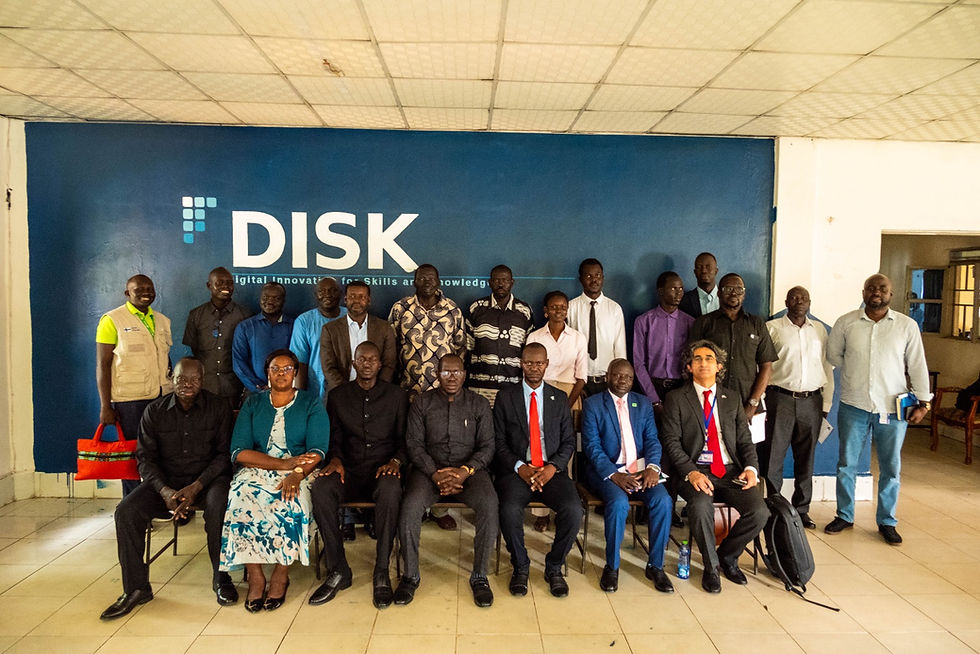
On Thursday, 1 October 2026, the community met at Scenius Hub in Juba. More than 100 participants joined, including students, developers, researchers, founders and industry professionals.
Inside AI: how it works, what it can do, and where it falls short
Poni Henry, Lead Organiser of IndabaX South Sudan, led the technical session. She went from a simple definition of AI to how machines learn, neural networks and how ChatGPT predicts the next word. She also provided resources for participants to explore a crop-yield model live in Google Colab. The session ended with AI's limits: bias, hallucinations, poor local fit, and the lack of data in South Sudanese local languages such as Dinka, Nuer, Bari and Juba Arabic.
Start Now: building AI and ML skills as a student
Chol Daniel Deng Dau, a software engineer and Technical Project Lead at Businesslab IT Services, shared a five-step learning path: Python, data handling, maths as you need it, ML fundamentals, then deep learning. He showed how his team built Unesis AI, which translates medical information into African languages, in 48 hours. It won 1st place at the ALU × Meta Hackathon 2024. His challenge to the room: pick one problem, build one project, and start this month.
AI in Banking: gains, risks and access to finance
Mabil Deng of Stanbic Bank South Sudan opened with a lightning talk on what AI has done for banking. He covered faster services, fraud detection and better credit decisions, as well as the risks: biased lending, privacy and AI-enabled scams. His main point was that AI in finance must be governed, and sensitive customer data should never be pasted into AI tools without safeguards. For South Sudan, he said, the biggest opportunity is reaching people the formal banking system has left out.
Founders panel: building for first-time users
Moderated by Gaso Grace Pascal, the panel brought together Nelson Kwaje (founder of Scenius Hub, CEO of Digital Rights Frontlines), John Marit (founder of Mobilaws) and Johnson Achuk (founder of AcademiaPro). They talked about a market where most customers are first-time digital users, and where trust has to come before features. All three already use AI in their work, from checking more than 15,000 documents a month to cleaning 17,000 spreadsheet entries in minutes. Their biggest needs: a more stable economy and real access to seed funding.
"We do product launches but we should also do funerals for projects that failed ," Kwaje said, encouraging founders to learn openly from failure.
Showcase: local solutions on display
Between sessions, participants explored exhibitions of AI and tech products built in and for South Sudan:
AcademiaPro is a school management system built only for South Sudanese schools. It follows the country's own school structure and curriculum, and takes paperwork off teachers so they can focus on students.
Strategos Edge is a private, local AI system for businesses and organisations. It analyses their own documents and data, such as sales, inventory, expenses and reports, without needing a constant internet connection. It answers management questions, spots operational issues and bases every answer on the evidence provided. It is designed for places where connectivity, privacy and access to cloud AI are real challenges.
Bilingual ai humaniod robot
A prototype AI humanoid robot that speaks both English and Arabic. It was built to promote peace, support digital farming and inspire interest in STEM education. By talking with people in two widely spoken languages, it makes technology easier to approach and shows how AI can serve communities in South Sudan.
Pathway AI
Pathway AI is an AI-powered career guidance system designed to recommend suitable fields of study based on students' skills, interests, and academic strengths.
A research poster on AI disinformation showed how false information created with AI spreads in South Sudan and why it matters to verify before sharing.
The day also celebrated the hackathon participants. Final winners will be announced once the code review of top submissions is complete.
What participants said
"We were literally building AI to predict food insecurity risk in our own counties — that's impact! This is how we use tech for South Sudan." — Deng Roadblock
"I learned that the hardest part isn't the model itself, it's the data, because with good and real data, you have everything." — Alek Madut Malual, top 10 participant
"I came to see that AI is not only about coding or computers. It has potential applications in education, agriculture, governance, research, communication, and community development." — Barnabas Lyd, Political Science student
"I gained new knowledge, connected with other young innovators, and became more confident in using AI to explore solutions to real-world challenges in my community." — Latjor Luk Reath, Medical Laboratory Sciences graduate, University of Juba
My experience at IndabaX South Sudan 2026 was inspiring and highly informative. I gained valuable knowledge about artificial intelligence, innovation, research, and entrepreneurship, and I learned how AI can contribute to solving real-world challenges in South Sudan, particularly in the health sector. The workshops, founders’ panel, research exhibitions, and networking opportunities gave me new ideas and motivated me to continue learning and exploring how technology can strengthen public health.
My dream has always been to make a real impact in my community, and this event showed me that it is possible through AI. Although I did not receive a certificate after participating in the amazing workshops and hackathon, I am not the same person as before. I now have solid practical skills in Artificial Intelligence, Machine Learning, and especially Deep Learning. IndabaX gave me not just knowledge, but direction and purpose. Thank you for bringing this opportunity to South Sudan - Bolis Joseph Agany Majak
Pictorials
What's next
IndabaX South Sudan 2026 showed that the talent is already here. What young builders need now is data, compute, connectivity and a community that keeps meeting. Next, Scenius Hub plans to turn the food security forecasting work into an open-source community project, so the models and insights keep growing after the competition. We will also continue hosting meetups and trainings throughout the year.
Thank you to every participant, speaker, panellist, exhibitor and facilitator. Thank you as well to Twenty11 Hub and to our partners, Google, Zindi, the Deep Learning Indaba, Digital Rights Frontlines (DRF) and Stanbic Bank South Sudan.
IndabaX South Sudan 2026 is organised by Scenius Hub as part of the Deep Learning Indaba network.


Comments